


Paramount's $110B Deal: Assessing WBD + NFLX Post Bidding War
How WBD went from priced for bankruptcy at $6 to a $31 per share buyout, why Netflix and Paramount both wanted it so badly, and what the stock analyzer says about WBD and NFLX today.
The Deal and the Bidding War
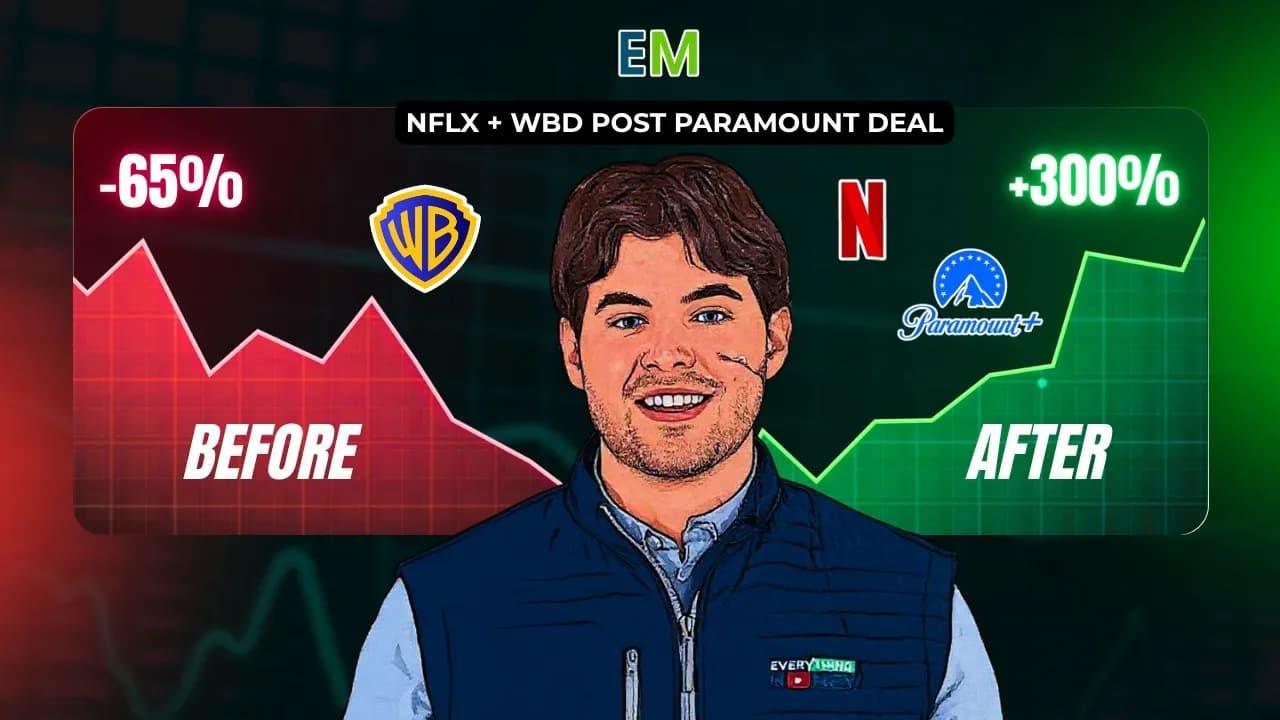
Warner Bros. Discovery had been carrying staggering amounts of debt since the Discovery-WarnerMedia merger in 2022. By late 2025, the board signaled it was exploring strategic alternatives. That was the starting gun. Netflix moved first. On December 4, 2025, the company proposed a $77.9 billion merger — planning to absorb WBD's studios, the DC Universe, Harry Potter, HBO, and the Max streaming platform while spinning off certain legacy assets. A definitive merger agreement was signed. The deal looked done. Then the DOJ intervened. In February 2026, regulators launched an intensive probe into whether a Netflix-WBD combination would create an insurmountable content monopoly. The specific concern was vertical integration — a dominant distribution platform owning too much of the content production pipeline. Paramount Global, led by David Ellison's Skydance consortium (you might recognize that last name), had been in a bidding frenzy with the streaming giant. On February 26, Netflix CEO Ted Sarandos announced they would not be bidding higher any further after WBD announced Paramount's offer had been superior, and walked away. Paramount had launched an all-cash tender offer at $31.00 per share — an enterprise value of approximately $110 billion. To remove every obstacle, Paramount agreed to cover the $2.8 billion breakup fee owed to Netflix. The WBD board has no financial reason to hesitate, and has fully recommended in support of the deal without wavering. The deal appears all but certain to close, and shares trade at only around a 10% gap to the proposed price which reflex a fairly high level of certainty as merger arbitrage goes.
Why Netflix and Paramount Both Wanted WBD So Badly
The Warner Bros. asset base is genuinely irreplaceable. The studio has been making films since 1923. DC, Harry Potter, The Lord of the Rings, the Matrix trilogy, the Dune franchise — decades of built cultural equity that cannot be assembled through production spend alone. And then there is HBO: The Sopranos, The Wire, Game of Thrones, Succession. The most prestigious television library in existence. For Netflix, WBD solved a structural problem. Every show Netflix makes starts with zero cultural equity and has to build its own audience from scratch. The Warner vault eliminates that entirely. Batman does not need an introduction. HBO does not need to prove its quality. Netflix was buying 100 years of brand equity in a single transaction. For Paramount, the logic was even simpler. Paramount is the smallest of the major studios. Mission: Impossible, Top Gun, NFL rights, and Paramount+ are strong assets — but not sufficient to compete for global streaming supremacy against Disney and Netflix at scale. WBD turns Paramount into a genuine rival to Disney overnight. The combined IP library, the merged streaming platform, the studio depth — it reshapes the competitive map quite a bit in all honesty.
How WBD Went From $6 to $31 Per Share
At the depths of its post-merger crisis, WBD shares traded between $6 and $8. The market was pricing in a real probability of debt restructuring. The combined entity had entered the merger carrying roughly $50 billion in gross debt, and in a rising rate environment that load was suffocating. Cable was declining faster than expected. Max was spending heavily without yet generating the profits to offset it. Every quarter felt like a survival exercise. I personally owned shares, reading the earnings reports was not pleasing the way it was for a company like Amazon or Microsoft with a clean balance sheet and massive growth. It was often a story of losses, revenue declines, discussions about how to change that. That being said, the assets were valuable. Zaslav (WBD CEO) made debt reduction the top priority — cutting content spend as much as possible and grinding the debt load down from $50 billion to approximately $29 billion. Max found its footing as the HBO brand attracted and retained subscribers at improving economics. And as the media consolidation narrative gathered steam, investors began pricing in M&A optionality long before Netflix made its formal bid. Shares had traded up fairly significantly well over 100% from the bottom before Netflix conversations picked up. The bidding war did the rest. Netflix's initial offer at $77.9 billion established a floor in many peoples eyes. Paramount's counters started a back and fourth which now has locked in a ceiling. Shareholders who held through the darkest period are being paid $31 per share in cash — a clean exit.
Warner Bros. Discovery: Stock Analyzer
With the deal at $31 per share all-cash, WBD at this point is essentially a spread trade priced near deal value. The more interesting exercise is understanding what the standalone business would have been worth without a buyer. Using revenue growth rates of 0%, 2%, and 4% alongside free cash flow margins of 8%, 11%, and 14% — and a multiple of 8 to 14 at year ten — the fair value range comes out as follows: the low scenario lands around $11, the middle around $20, and the high scenario approaches $32. So what does this tell us, it makes sense why Netflix and Paramount wanted to own the assets. Paramount likely paid $31 (which is at the top of range) because it is not buying a standalone WBD — it is buying the strategic combination value of those assets inside a merged entity. They will be able to save cost when the two entities are combined. For WBD shareholders, that is a clean exit at the top of the fair value range from a stock that was priced for potential ruin not long ago.
Netflix Gets $2.8 Billion to Walk Away
Netflix did not just lose a bidding war though that's the interesting part. It walked away with $2.8 billion — a breakup fee that Paramount agreed to cover as part of its counter-offer. To put that number in context, Netflix's reported net income last quarter was just over $2.4 billion. The breakup fee is larger than a full quarter of current profit. It is, as one analyst put it, found money. Netflix spent approximately $17 billion on content in 2025. The $2.8 billion is essentially a 16% addition to that budget, arriving with no integration cost and no regulatory burden attached. The most likely deployment is back into content — accelerating high-profile originals, expanding international production, or making a selective move into sports rights where Netflix has been cautiously investing. Share repurchases are another potential use as the business has seen shares fall from a high of $133 down to as low as $75 touching that 200WMA. The honest question is whether Netflix actually lost. It avoided a deeply complex regulatory battle that could have consumed years and billions in legal costs. It avoided absorbing $29 billion in WBD debt. It avoided integrating two large organizations with very different cultures. And it walks away liquid and focused. The company's organic model built the largest global streaming service in history without owning a legacy studio. The question now is whether that model remains sufficient as the New Paramount consolidates DC, Harry Potter, HBO, and Mission: Impossible under one roof.
Netflix: Stock Analyzer
Netflix entering 2026 is a fundamentally different business than the one burning cash to build scale a few years ago. Free cash flow has inflected positively, the ad-supported tier is adding a new monetization layer, and the subscriber base is the largest in streaming history. The question is whether the current premium valuation of 36x earnings prices in too much optimism still after this pullback. Using revenue growth rates of 8%, 10%, and 12% alongside profit margins of 21%, 24%, and 27% — with a PE of 20 to 26 at year ten — the fair value range is approximately $60 on the low end, $87 in the middle, and $126 on the high end. The wide spread reflects genuine uncertainty about the long-term competitive position and growth story. The low scenario prices in meaningful pressure from the New Paramount and slowing subscriber growth. The middle reflects continued execution on the current strategy (I covered NFLX earnings on EM+ recently where they guided for lower growth than expected next year). The high requires the ad tier and international markets to compound in a way that drives both revenue and margin significantly higher over the decade. At current trading levels it appears the market is pricing Netflix around fairly valued — and it may have become attractive as it fell. I know I had a lot of conversation with members of our software who were interested sub $80 because they viewed it as a high-quality compounder at a discount to value because of a short-term distraction of WBD bidding war.
Final Thoughts
The Paramount-WBD deal is the most consequential media transaction since Disney acquired 21st Century Fox in 2019. The consolidation era is here — fewer, bigger players controlling the content libraries and streaming platforms that global audiences depend on. For WBD shareholders the story is already mostly written and it appears to have ended well. For Paramount, the hard work is just beginning. For Netflix, the $2.8 billion is a tailwind but the New Paramount is a real competitive threat that will take years to fully understand. Swap in your own assumptions on the stock analyzer and let me know where you land on both WBD and NFLX. Tag me in the community and let's dig into it.

Disclaimer
Everything Money is Not an Investment Advisor: Everything Money (including Paul, Mo, and Any other person including, but not limited to, other staff members, guests, personalities, etc.) is not an investment adviser, and it is not registered as such with the U.S. Securities & Exchange Commission or any other state or federal authority under the Investment Advisers Act of 1940 or any other law. The investments and strategies discussed in Everything Money’s YouTube videos and on Everythingmoney.com are not and should not be considered investment advice and may not be suitable for you. They do not take into account your particular investment objectives, financial situation, needs, or personal circumstances and are not intended to be specific to you. Before acting on any investment or strategy discussed, you should always do your own research and make your own independent decision about whether it is suitable for your particular circumstances. You should also consider seeking advice from your own legal, financial, tax, accounting, or investment advisers. Everything Money does not provide such advice.
READ THE FULL DISCLAIMER HERE: https://everythingmoney.com/disclaimer